Charging your EV in Milan

Milan is the easiest big Italian city to drive into: a fully electric car is exempt from the Area C charge and enters Area B freely, so the cameras at the gates are not your problem. Parking is — so do what Milan does: charge in a garage or at a park-and-ride on the metro, and ride in. The same app and free card you use at home work there, at the fast hubs on the tangenziali, and right across Italy.

See the live price before you plug in. One app, one free card — across Milan and all of Europe.

  • Know the price before you charge
  • Free RFID card
  • No subscription
  • Pay as you charge

What charging costs in Milan

Charging in Milan costs what it costs across Italy: around €0.70 per kWh at an AC post and €0.80 to €0.99 at a fast charger at the big networks’ ad-hoc prices, with an occupancy fee per minute at many points once charging ends — and the price for your account is the one the app shows before you plug in. The bigger number is parking: €3 an hour on the blue lines inside the Bastioni ring, two hours maximum, €2 an hour inside the outer ring and €1.20 beyond it, and the free parking the city offers electric cars is for residents, so it is not yours with a UK plate. easyCharging shows the live price at each point up front, so you choose on cost, not guesswork.

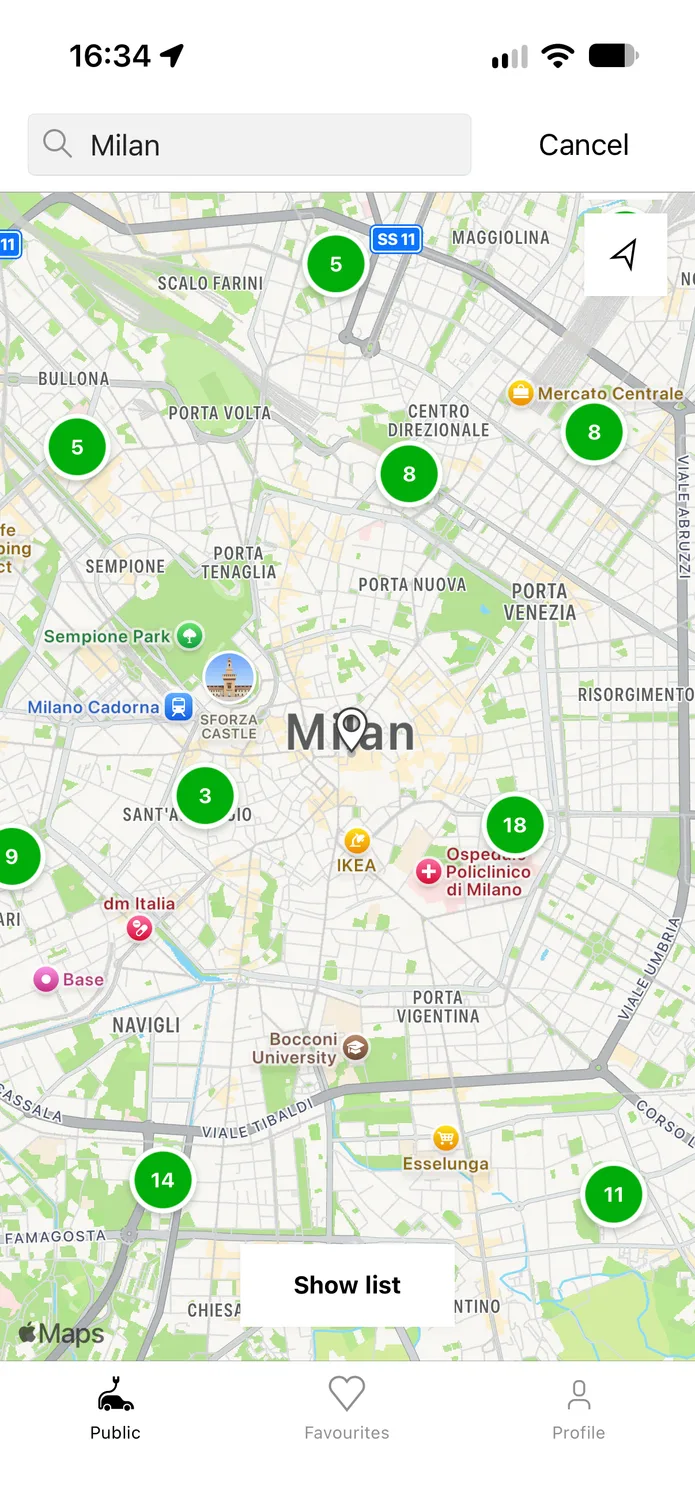
Open the app to see live availability and price across Milan’s kerbside posts, garages, park-and-ride bays and hubs on one map.

The easyCharging app showing a live map of charging points across Milan.

Charging rules and practicalities in Milan

A few local things worth knowing before you charge in the city — what the two camera zones mean for an electric car, what a kerbside bay costs you, and why the car is happiest left on the metro.

  1. Area C and Area B: free for an electric car — register the plate anyway

    Area C is the congestion charge for the centre inside the Bastioni ring: €7.50 a day for a combustion car, and a battery-electric car is exempt. Area B is the low-emission zone covering almost the whole city: it bans older combustion cars and lets an electric car in freely. Both are camera-enforced at their gates. The city registers vehicles on its MyAreaC portal, and with a foreign plate it is worth registering there before you drive in rather than relying on a camera to read a UK plate as electric — a missed exemption is a fine, not a warning. The winter anti-smog stops across Lombardy work the same way: combustion cars by Euro class, electric cars never.

  2. If you do charge at the kerb

    A bay marked for electric vehicle charging is for a car that is charging: national law fines an EV left plugged in more than an hour after charging ends — except between 23:00 and 07:00 at ordinary points — from €87. Milan’s kerbside posts are Type 2 sockets, so bring your own cable, and they sit on paid streets: €3 an hour inside the Bastioni with a two-hour limit, €2 an hour inside the outer ring, €1.20 beyond, weekdays 08:00–19:00 and longer in the centre. The city’s free parking for electric cars is a residents’ pass, so pay the meter or the parking app for as long as you are plugged in. Posts in the central districts fill up in the evening; check live availability in the app before you set off.

  3. Tangenziali, the free-flow A36 and the hubs at the edge

    Milan’s ring is three tolled tangenziali — Est, Ovest and Nord — with fast-charging hubs at the retail parks off their junctions and at the service areas of the A4, A1, A7 and A8 beyond, where you will find the highest powers in the city. The A36 Pedemontana to the north is free-flow: no barriers, a camera reads the plate, and you pay online within 15 days or a fine follows the plate home. Park-and-ride car parks at the outer metro stations are the cheap way to leave the car for the day; several have charging bays, and the app shows which are free. See more on the Italy guide.

How charging works in Milan

Create your account

Download the easyCharging app on Android or iOS and create your account before you cross the Alps. Add a payment method once and the same login works at the service areas on the way down, in Milan’s garages and on into the rest of Italy — no Italian app, no prepaid credit to load at the border.

Choose the garage before you reach the centre

Before you leave the tangenziale, pick where the car will sleep: filter the map for the garage and park-and-ride bays on the metro, or for a kerbside post outside your hotel, and check it is free and what it costs right now — the price shown is the price for your account, not a different card’s.

Plug in, or tap the card underground

At a kerbside post, plug in with your own Type 2 cable and start the session in the app; in an underground garage, where the signal often drops, tap your free RFID card on the reader instead. Pay the parking at the meter or in the parking app for as long as you are plugged in, and move the car within an hour of the charge finishing.

Unplug and continue

Stop charging in the app, unplug and go — into the centre on the metro, or east on the A4 towards the lakes and Venice. The charging summary arrives in the app and payment is handled automatically, so a stopover in Milan costs one line on one bill, not a new account.

Beyond Milan: one app for Europe

Leave the tangenziale and the same app and free card keep working — across Italy and over the Alps. One app, one free card and a live price the whole way.

Milan → Aosta → the Mont Blanc tunnel, France (A4 / A5)

The way home for most UK drivers: the A4 west and the A5 up the Aosta valley, two hours to Aosta and half an hour more to the tunnel mouth at Courmayeur, with fast charging at the valley’s service areas for the last Italian top-up. The tunnel is €55.50 one way for a car in 2026, paid by card at the booth. The same app and free card keep working through the tunnel and up through France, with the live price before you plug in at every stop.


Milan → Como → Chiasso, Switzerland (cross-border, A9)

North on the A9 past Como to the Swiss border at Chiasso in under an hour, then Lugano and the Gotthard towards Zürich or Basel. Switzerland needs its CHF 40 motorway vignette, EVs included, bought before you reach the border; the charging needs nothing new — one app and one free card cover both sides, with the live price shown before you plug in.

Milan → Verona → Venice (A4)

East on the A4 through Bergamo and Brescia to Verona and Lake Garda in an hour and a half, and Venice in about three. The Po plain is the best-charged region in Italy and the A4’s service areas are thick with fast chargers, so this is the drive where range is least of a worry — charge at Mestre before the causeway and leave the car at the edge of a city with no roads.

The old way: an app for every network

6 logins · 6 cards · 6 separate bills

The easyCharging way

One app and a free RFID card replace the glovebox full of cards — kerb, garage and hub in Milan, then Italy and Europe, on one bill.

1 app · 1 free card · 1 bill

Why drivers choose easyCharging in Milan

Built for a city where the gates are open to you, the parking is not, and the car is best left on the metro.

Kerb, garage and hub in one app

Kerbside posts, garage bays, park-and-ride sites and the hubs on the tangenziali from a dozen networks, on one map with one account — no app-hopping to find out which is free.

The price for your account, up front

Milan’s kerbside posts, its garages and the hubs on the tangenziali belong to different networks with different ad-hoc prices. The app shows the price for your account at each one before you plug in, so a stopover on the way south does not turn into a guess.

A card for the garages

Milan’s garages go two and three levels down, where the phone signal stops. A free RFID card starts the charge at the bay without the app — and the garage is where you will leave the car if you take the local advice.

No subscription for a stopover

Pay only for the sessions you use. No monthly fee, no prepaid credit — ideal for a night in Milan on the way south, or a city break where the car charges twice and walks the rest.

Charging in other cities across Europe

Milan charging FAQ

Answers to the most common questions about charging an electric car in Milan — prices, Area C and Area B, parking at the bay, rapid chargers and using the same app abroad.

How much does charging cost in Milan?

About the same as anywhere in Italy: around €0.70 per kWh at an AC post and €0.80 to €0.99 at a fast charger at the big networks’ ad-hoc prices, often with an occupancy fee per minute once charging ends. Street parking is on top — €3 an hour inside the Bastioni ring, €2 inside the outer ring, €1.20 beyond — for the whole time you are plugged in. easyCharging shows the live price for each charger before you plug in, so you choose on cost rather than guesswork.

Where is the cheapest place to charge in Milan?

At the edge rather than in the centre. The park-and-ride car parks at the outer metro stations and the hubs at the retail parks off the tangenziali cost far less to stop at than a blue bay inside the Bastioni, and a fast charger there does in half an hour what a kerbside post does over dinner. The app shows the live price and availability of all of them, so you can compare before you drive in.

Can I drive my electric car into Area C and Area B?

Yes. A battery-electric car is exempt from the Area C ticket — €7.50 a day for a combustion car — and enters Area B freely; both are the city’s own rules for 2026. The zones are camera-enforced at their gates, so with a UK plate register the car on the city’s MyAreaC portal before you drive in, rather than rely on a camera reading a foreign plate as electric.

Can I park free on Milan’s blue lines with an electric car?

No. Milan’s free parking for electric cars is a pass for people who live, work or are domiciled in the city, not for visitors. Count on paying: €3 an hour inside the Bastioni ring with a two-hour limit, €2 an hour inside the outer ring and €1.20 beyond it, at the meter or in the parking app, for as long as you are plugged in.

Does Milan have a low-emission zone, and does it apply to electric cars?

Area B is the low-emission zone and covers almost the whole city; it bans older petrol and diesel cars by Euro class and lets an electric car in freely, whatever its plate. The winter anti-smog stops across Lombardy work the same way and never affect an electric car. Area C, inside the Bastioni, is a congestion charge rather than an emission rule, and an electric car is exempt from it too.

Where are the rapid chargers in Milan?

At the hubs on and around the tangenziali — the retail parks and shopping centres off their junctions — at the service areas of the A4, A1, A7 and A8 as you leave, and around Malpensa and Linate. Inside the Bastioni the network is kerbside AC posts. You can find them live in the app, with availability and the current price shown before you go.

How do I pay for charging in Milan?

You pay through the easyCharging app with the payment method on your account. Payment is handled automatically after each session and you receive a charging summary — no subscription, no prepaid credit and no monthly invoices. Street parking and the park-and-ride are paid separately to the city or the garage.

Can I use the same app outside Milan or abroad?

Yes. The same app and free card work across Italy and over the border, so you can drive from Milan to Venice or Rome, up through Chiasso into Switzerland or home through the Mont Blanc tunnel and keep charging with one app — no second account.

See all questions

Ready to charge in Milan? Get the app and order your free RFID card.

Get started

English support 24/7

Explore our extensive network

easyCharging offers access to a vast network of 900,000+ charging points across Europe