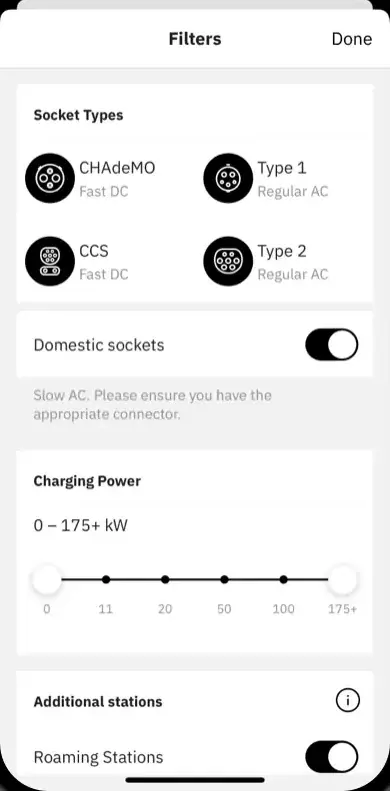
easyCharging app filter to select charging plug

One app that works with every EV and every charger

Almost every electric car sold in Europe charges on Type 2 (AC) or CCS (DC) — and easyCharging works with all of them. Instantly see which chargers match your vehicle, filter by connector, and access over 900,000 compatible points across 35 countries.

Will easyCharging work with your EV?

In almost every case, yes — fast charging made simple in one app.

Thanks to common European standards, nearly every electric car on the road shares the same two connectors, so you don't have to worry about whether a station will fit your vehicle. Below, we explain the plug types, show how the major manufacturers charge, and answer the questions drivers ask most often — whatever you drive, easyCharging helps you find compatible charging points across Europe with one app and one free RFID card.

Icon

Type 2 (Mennekes)

Type 2 (Mennekes) is the European AC charging standard and the most common plug for everyday charging. Supports single-phase and three-phase power, making it ideal for home, workplace, and public AC stations. Reliable, universal, and built into nearly all modern EVs.
Icon

CCS (Combined Charging System)

CCS combines AC and DC charging in a single connector, enabling both slow charging and ultra-fast DC charging. The most widely adopted fast-charging standard in Europe, compatible with almost all new EV models.

Icon

CHAdeMO

CHAdeMO is a proven DC fast-charging standard used by brands such as Nissan and Mitsubishi. Although less common today, easyCharging helps you locate compatible CHAdeMO points quickly and reliably for long trips.

Not sure which plug your car uses? It’s shown on your charge port and in the easyCharging app.

Compatible EV manufacturers

Nearly every electric car on European roads uses Type 2 for AC and CCS for DC charging — so easyCharging works with them all. Here’s how the major brands charge.

Audi

Audi's e-tron range, including the Q6 e-tron on the new PPE platform, charges on Type 2 for AC and CCS for DC. Newer models use an 800V architecture for ultra-rapid DC charging on longer trips.

BMW

BMW's i-series charges on Type 2 and CCS across the lineup. The latest Neue Klasse models move to an 800V system for faster DC charging and more range between stops.

BYD

BYD's EVs, including the Dolphin and Atto 3, use the European standard — Type 2 for AC and CCS for DC rapid charging. No adapter is needed at public stations.

Citroën

Citroën's electric range — the ë-C3, ë-C4 and compact Ami — charges on Type 2 and CCS. Designed for easy everyday city and public charging.

Cupra

Cupra's Born and Tavascan share the Volkswagen Group MEB platform, charging on Type 2 for AC and CCS for DC. Widely compatible across European rapid-charging networks.

Dacia

The Dacia Spring is an affordable city EV that charges on Type 2 for AC and CCS for DC. Compact and simple, it works at standard public chargers everywhere.

Fiat

Fiat's 500e and Grande Panda are compact city EVs charging on Type 2 and CCS. Ideal for urban AC charging, with DC rapid charging when you travel.

Ford

Ford's electric range — Mustang Mach-E, Explorer and Capri — charges on Type 2 and CCS. Built for both everyday AC charging and rapid DC top-ups on the road.

Genesis

Genesis builds its luxury EVs, such as the GV60, on the 800V E-GMP platform, charging on Type 2 and CCS. The high-voltage architecture enables very fast DC charging.

Hyundai

Hyundai's IONIQ range uses the 800V E-GMP platform with Type 2 and CCS connectors — one of the fastest-charging systems available, ideal for long-distance driving.

Jaguar

The Jaguar I-PACE and Jaguar's new electric models charge on Type 2 for AC and CCS for DC. Standard European connectors mean no adapter at public points.

Kia

Kia's EV6 and EV9 share Hyundai's 800V E-GMP platform, charging on Type 2 and CCS. Ultra-rapid DC charging makes long trips quick and predictable.

Mazda

Mazda's MX-30 and new electric models charge on Type 2 for AC and CCS for DC — the standard connectors used across Europe.

Mercedes-Benz

Mercedes' EQ range and new electric models charge on Type 2 and CCS. Newer models adopt an 800V architecture for faster DC charging.

MG

MG's popular-value EVs, including the MG4, charge on Type 2 for AC and CCS for DC. Standard connectors keep them compatible with public networks across Europe.

Mini

The Mini Cooper Electric and Aceman charge on Type 2 and CCS. Compact EVs designed for easy city AC charging and DC top-ups when needed.

Nissan

Newer Nissans like the Ariya use Type 2 and CCS, while the older LEAF uses Type 2 for AC and CHAdeMO for DC. easyCharging helps you find the right connector either way.

Opel

Opel's Corsa, Mokka and Astra Electric charge on Type 2 and CCS. Practical EVs built for everyday AC charging and rapid DC when you travel.

Peugeot

Peugeot's e-208, e-2008 and e-3008 charge on Type 2 for AC and CCS for DC. Standard European connectors across the electric range.

Polestar

Polestar 2, 3 and 4 charge on Type 2 for AC and CCS for DC. Newer models use a higher-voltage architecture for faster DC charging.

Porsche

The Porsche Taycan and Macan Electric use an 800V architecture with Type 2 and CCS connectors — among the fastest DC charging available.

Renault

Renault's Megane, Scenic and R5 E-Tech charge on Type 2 and CCS. Designed for easy city AC charging, with DC rapid charging on longer journeys.

Škoda

Škoda's Enyaq and Elroq use the MEB platform, charging on Type 2 and CCS. Spacious, practical EVs compatible with public networks across Europe.

Smart

Smart's #1 and #3 charge on Type 2 for AC and CCS for DC. Compact EVs that work at standard public chargers across the continent.

Tesla

Teslas sold in Europe — the Model 3, Y, S and X — use CCS natively, charging at public CCS points and at Tesla Superchargers open to other EVs. No adapter required.

Toyota

Toyota's bZ4X and electric range charge on Type 2 for AC and CCS for DC, the European standards. Compatible with public networks across the continent.

Volkswagen

Volkswagen's ID. family uses the MEB platform, charging on Type 2 for AC and CCS for DC. One of Europe's most common EV platforms, widely supported everywhere.

Volvo

Volvo's EX and EC range charges on Type 2 and CCS, with newer models adopting an 800V architecture for faster DC charging.

Drive something not listed? If it’s an EV with a Type 2 or CCS port — which is almost every model in Europe — easyCharging works with it.

900,000+ compatible charging points across Europe

easyCharging makes compatibility effortless. Filter the map to see only the stations that fit your car, then start and pay in a few taps — at home or anywhere across Europe.


  • Filter by connector — Type 2, CCS or CHAdeMO
  • Filter by AC or DC and by charging power
  • See live availability and pricing before you go
  • Free to register, with no monthly fees
  • Free RFID card that works across 35 countries
  • 24/7 customer support
Get the app
EV charging with easyCharging

EV compatibility — frequently asked questions

If you drive an electric car in Europe, almost certainly yes. Nearly every EV sold here charges on Type 2 (AC) or CCS (DC), and easyCharging supports both across its network of 900,000+ points in 35 countries.

Most modern EVs use Type 2 for AC charging and CCS for DC rapid charging — the same port handles both. A few older models, such as the early Nissan LEAF, use CHAdeMO for DC. The shape of your charge port tells you which, and the app filters stations by connector.

AC charging draws power that your car converts on board — it's slower and ideal for home, workplace and overnight charging. DC charging delivers power directly to the battery for much faster top-ups, which is what you use at motorway and rapid-charging hubs. Type 2 carries AC; CCS and CHAdeMO carry DC.

They're related. CCS (Combo 2) builds on the Type 2 plug by adding two extra high-power pins underneath it for DC charging. That's why most European EVs have a single combined port: the top handles Type 2 AC charging and the full connector handles CCS DC charging.

For AC (Type 2) charging you usually plug in your own cable; for DC rapid charging the cable is attached to the charger. easyCharging helps you find the right station for either kind of session.

In Europe, almost never. The shared Type 2 and CCS standards mean your car's native plug already fits public chargers — including Teslas, which use CCS here. easyCharging shows which stations match your connector so you don't arrive at the wrong kind.

Yes. Tesla cars sold in Europe use CCS, so they charge at public CCS points through easyCharging — including Tesla Superchargers that are open to other EVs. No adapter needed.

They're covered. CHAdeMO is less common today, but easyCharging helps you locate compatible CHAdeMO points so older EVs — like the early Nissan LEAF — can charge reliably on longer trips.

Yes. Plug-in hybrids charge on Type 2 AC, which easyCharging supports across its European network of public charging points.

That depends on your car and the station. Your charging speed is limited by whichever is lower: your car's maximum charging rate or the station's output. Cars on 800V platforms charge fastest on high-power DC chargers. easyCharging lets you filter by power level so you can pick a station that suits your car.

Yes. One easyCharging app and one free RFID card work across borders in 35 countries, so you don't need a different app or card in each market.

Latest Articles

EV Charging Costs in 2026: How Much Per kWh Across Europe

EV Charging Costs in 2026: How Much Per kWh Across Europe

Charging an electric car on Europe's public fast-charging networks costs roughly €0.38 to €0.82 per kWh in 2026 — and the gap between countries is wider than most drivers expect. This guide breaks down what you actually pay per kWh across Europe, why AC and DC prices differ, and how to check the real price before you plug in.

Northern Spain Wine & Coast EV Circuit Road Trip from Madrid

Northern Spain Wine & Coast EV Circuit Road Trip from Madrid

Experience Spain's finest wine regions and dramatic coastlines on this comprehensive 2,200km electric vehicle circuit from Madrid through Castile, Rioja, the Basque Country, and Asturias. With extensive EV charging infrastructure and the convenience of the easyCharging app, sustainable travel has never been more rewarding. From medieval Salamanca to gastronomic San Sebastián, experience Spain's cultural treasures whilst enjoying the quiet comfort and environmental benefits of electric driving.

Off-the-Beaten-Path EV Adventures Across Europe

Off-the-Beaten-Path EV Adventures Across Europe

Forget the crowded tourist trails—Europe's most spectacular hidden gems are now fully accessible to electric vehicle adventurers. While millions flock to overtouristed hotspots, a new generation of EV explorers is discovering pristine wilderness areas, forgotten mountain valleys, and authentic cultural experiences that remain blissfully undiscovered by mainstream tourism. From Slovenia's emerald Soča Valley to the mystical Franco-Swiss Jura Mountains, these off-the-beaten-path destinations offer the perfect combination of breathtaking scenery and comprehensive charging infrastructure, proving that sustainable adventure travel has never been more rewarding.

Explore our extensive network

easyCharging offers access to a vast network of 900,000+ charging points across Europe

One app for stress-free EV charging

Filter chargers by speed and connector
Detailed station information
Save frequently used stations
Manage charging sessions in-app
Access complete charging history
Clean, easy-to-use design
Get the app
It's free to download and use the app.
Top