

EV charging in Portugal — a visiting driver’s guide

One app. One account. From home to Portugal.

Portugal is the far corner of the map. By road it is about 1,840 km from Calais to Porto and 2,000 to Lisbon; Brittany Ferries’ sailings to Santander and Bilbao cut that to 640–860 km of Spanish and Portuguese motorway. At the end waits a national charging network that reaches every one of the country’s 308 municipalities — more than 16,000 public points, about four in ten of its stations fast or ultra-fast — and motorways that got cheaper: since January 2025 some 950 km of them, the whole Algarve coast road included, carry no toll at all. Portugal is easyCharging’s newest market, and its network there grows as Portuguese operators join, so the app shows you exactly where it works, with the price in euros, before you plan a stop around it.

  • No subscriptions
  • Pay only when you charge
  • No Portuguese contract
  • App or RFID key tag
Lisbon EV charging
Porto EV charging
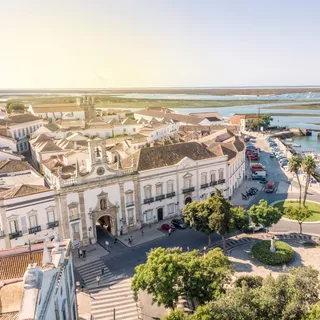
Faro EV charging
Évora EV charging

From the Douro to the Algarve, one way to charge

Whether you’re rolling off the ferry at Santander with Porto a day’s drive away or heading for the Algarve beaches, easyCharging works exactly as it does at home wherever it has a charger — one app, a price you see before you plug in — and tells you plainly where it doesn’t yet.

Know which chargers the app covers

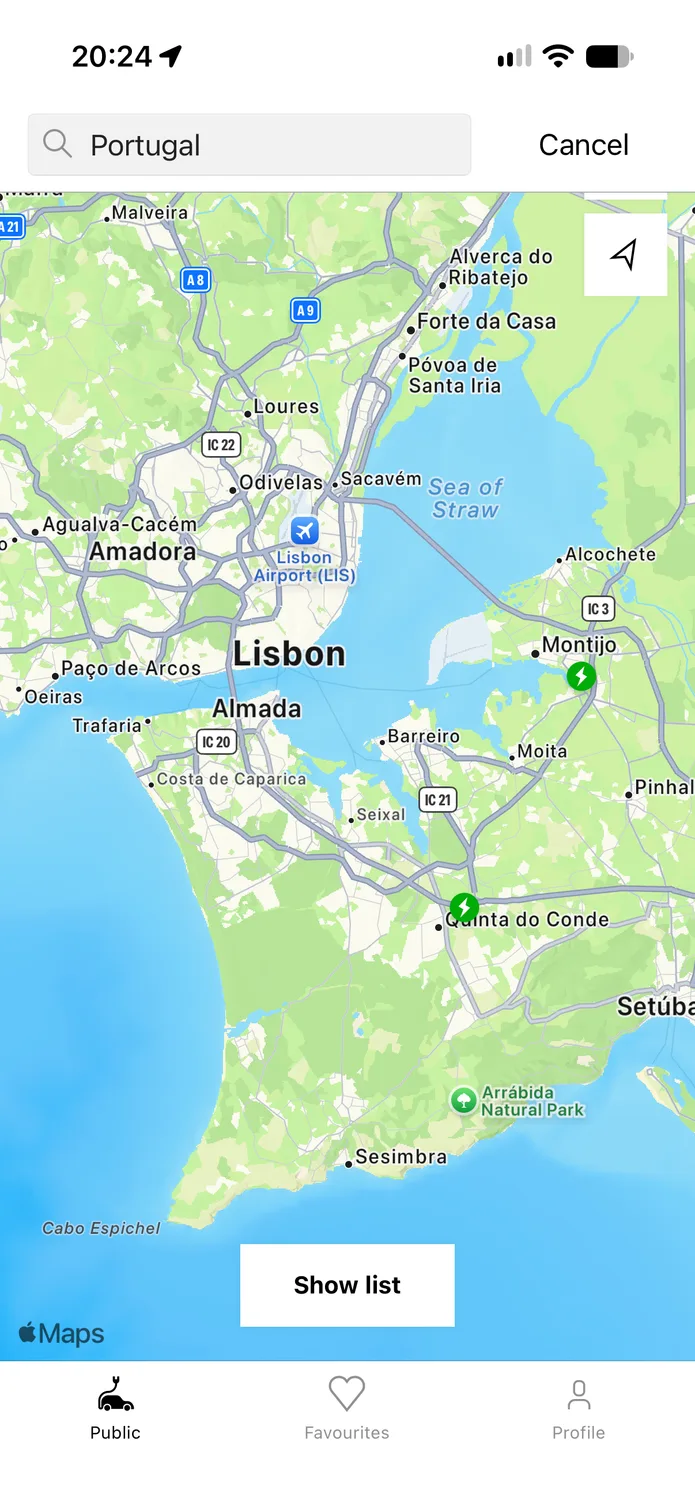
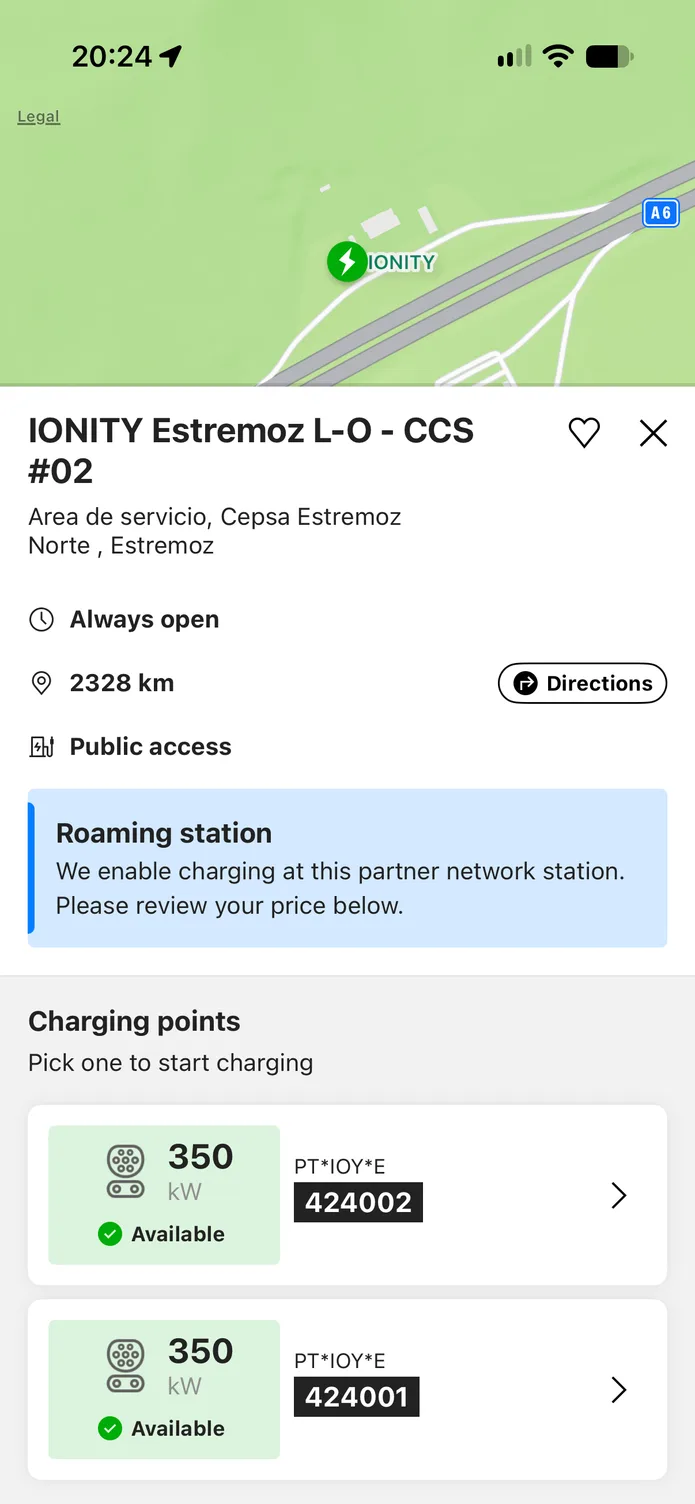
Portugal built one national charging network, MOBI.E, and it reaches every municipality on the mainland, Madeira and the Azores — more than 16,000 public points at the kerb, in town car parks, at supermarkets, hotels and wineries. easyCharging’s roaming network there is new and growing, with more points added as operators join; the app’s live map shows exactly which work with your account, so you know before you set off rather than at the charger.
Spend less time charging, more time travelling

The service areas on the A1 and A2 between Lisbon, Porto and the Algarve have gained high-power hubs with card terminals through 2026 — where the app has no charger, a bank card does the job. Check the app first for the stops it covers, then plan the rest of the run down from the Spanish border around the card-payment hubs.

Know what’s available before you arrive

See live availability, power levels and pricing in the app. Plan ahead where it counts: inland, in Trás-os-Montes, the Beiras and the Alentejo, the chargers thin out away from the motorways, and a mountain road up to the Serra da Estrela eats range on the way up.

Get the app

Charging your EV in Portugal — step by step

Open the app and plan ahead

Before you travel, open the easyCharging app to see which Portuguese chargers it covers today — the list grows as operators join — and check their power, pricing and live availability. Plan the rest of the route around chargers that take a bank card; inland, find the next stop before you leave the last one.

Park and start your session

Park at the charging bay and plug in — Portuguese AC posts are Type 2 sockets rather than tethered cables, so keep your own cable in the boot; the fast chargers have their cables fixed. A bay signed for electric vehicles is theirs alone. At a charger the app covers, start the session in the easyCharging app, or tap your RFID key tag on the reader if mobile signal is weak.

Charge while you take a break

At a fast charger on the A1 or A2, a stop is long enough for a bica and a pastel de nata. In towns, an AC post suits lunch or an overnight stay — but many Portuguese chargers add a price per minute to the price per kWh, so don’t leave the car plugged in long after it is full. You can monitor progress live in the app.

Unplug and continue your journey

Stop charging in the app, unplug and continue your journey. Payment is handled automatically and you’ll receive a receipt instantly — no subscriptions, no monthly invoices.

Portugal on the easyCharging map

easyCharging’s network in Portugal is new and growing: more compatible charging points appear in the app as Portuguese operators join the networks it roams on — part of a network of 900,000+ charging points across Europe.

Where the app doesn’t cover a charger yet, you are not stuck: the newest fast chargers take bank cards, and from January 2027 every older one of 50 kW or more must too.

Check the live map before you travel — it shows only what works with your account.

Where Portugal’s network is densest: the Lisbon and Porto metropolitan areas.

City guide: Lisbon — tolls, parking and the streets a visiting car cannot enter.

Portugal on the live map

No Portuguese charging contract to sign

For fifteen years a Portuguese public charger was built to be used through a contract with an electric-mobility supplier, and many visiting drivers still assume they need one — or a stack of local apps. A 2025 law is phasing that system out by the end of 2027. Wherever easyCharging has a charger in Portugal, you use the same app and account you already use at home — no contract, during the change-over and after it.

easyCharging

Same app · Same account · No subscription

Get the app

Local apps

Country-specific charging providers

Charging coverage
easyChargingGrowing in Portugal, wide across EuropeThe live map shows each point it covers
Local appsOften network-specificCoverage varies by operator or region
Account & setup
easyChargingNo new setupUse your existing UK account
Local appsSupplier contract or new appOften Portuguese-first onboarding
Payments
easyChargingPay as you chargeInstant billing, no invoices
Local appsItemised billsEnergy, operator and network fees
RFID charging
easyChargingSame RFID key tagWorks even with poor signal
Local appsSeparate cardsOften tied to one supplier
Charging history
easyChargingAll sessions in one placeIdeal for trips and expenses
Local appsSplit across appsHarder to track journeys

One app, from home to Portugal

  • Clear pricing before you plug in

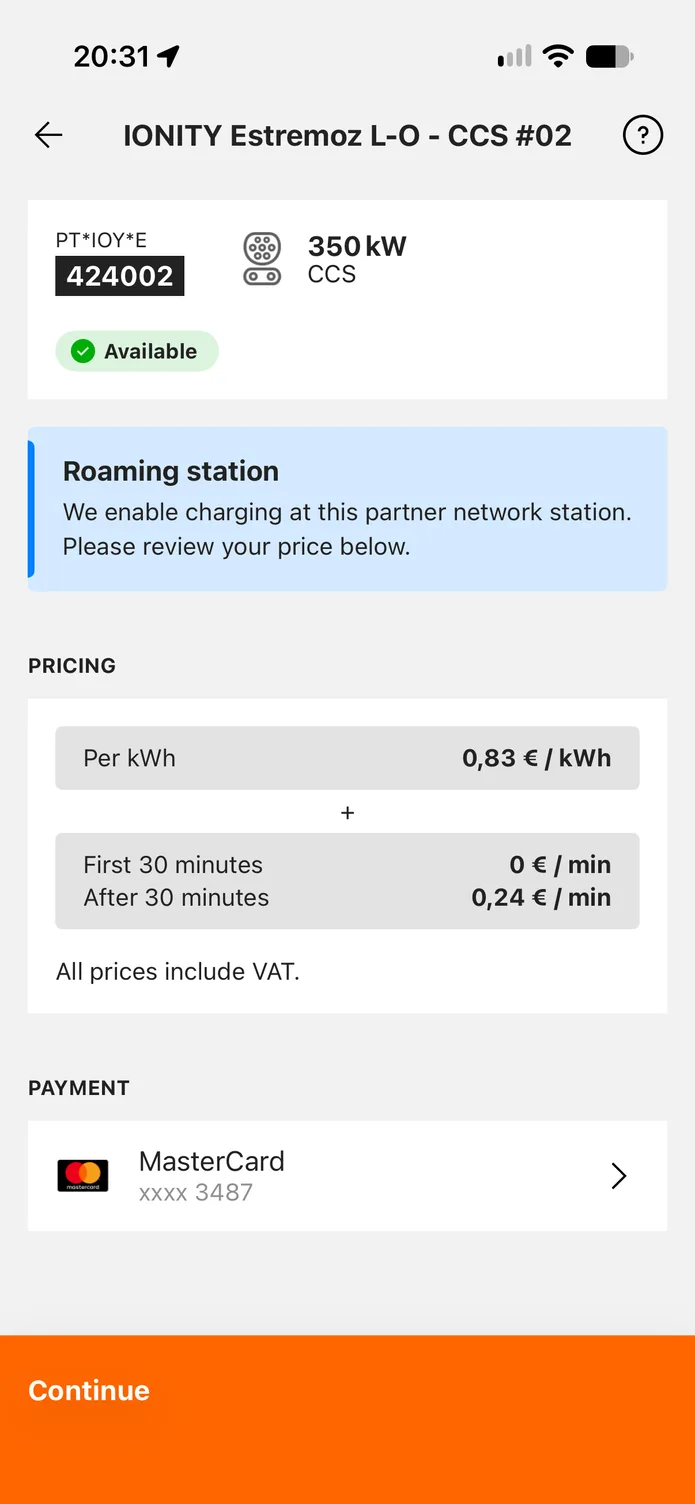
    See charging prices upfront — per kWh, per minute and per session — so you know what you’ll pay before charging in Portugal, where a single session can carry all three.

  • Pay only when you charge

    No subscriptions, no Portuguese supplier to sign up with. You’re charged instantly after each session — just like at home in the UK.

  • All your charging in one place

    Every charging session in Portugal appears in your history — locations, costs and energy usage, all in one app.

The easyCharging app showing a nearby charging station: its charging points, the price per kWh before you plug in, and a swipe control to start charging.The easyCharging app showing a charging station found on the map: its address and charging points, with the map still visible above.The easyCharging app showing a live map of charging points across Lisbon.
  • Save stations you use on your route

    Favourite the chargers the app covers on your route, and watch the map fill in as more Portuguese operators join.

  • Works with your EV in Portugal

    easyCharging supports all major EV brands and the connectors used across Portugal and the UK — Type 2 at the AC posts, CCS at the rapid hubs.

  • App or RFID key tag

    Start charging with the app or use your easyCharging RFID key tag — useful in underground car parks, or in the hills of the interior where mobile signal drops.

Charge in Portugal with a free RFID key tag

Start and stop charging instantly using the easyCharging app or our RFID key tag. Ideal when travelling abroad, in underground car parks, or wherever mobile signal is weak.

One app for the UK and Portugal — get the app and order your FREE RFID key tag.

Popular EV routes across Portugal — and the way in through Spain

From the ferry ports of northern Spain to Porto, Lisbon and the Algarve, these are the routes UK EV drivers travel most in Portugal — and where easyCharging helps keep journeys simple and predictable.

Portsmouth or Plymouth → Santander or Bilbao by ferry

The way to skip France: Brittany Ferries sails from Portsmouth to Santander and to Bilbao all year, and from Plymouth to Santander in season — a night or two at sea rather than two days at the wheel. There is no charging on board, so top up at Portsmouth before you sail, and plan the first Spanish stop in the app while you are still at sea. Porto is then about 640 km from Santander, Lisbon about 830. Spain requires a UK sticker on a UK car whatever the number plate shows.

Calais → Bordeaux → Irun → Salamanca → Vilar Formoso (A63 / A-62 / A25)

The all-road route: down through France to Bordeaux and the border at Irun, across the plateau of Castile and León to Salamanca, and into Portugal at Vilar Formoso — about 1,840 km from Calais to Porto and 2,000 to Lisbon. The A25 from the border towards the coast has been toll-free since 2025. easyCharging shows chargers live in France and Spain, and the Portuguese points it covers, so the stops across the Spanish meseta, where towns are far apart, are planned before you leave.

Lisbon → Coimbra → Porto (A1)

The spine of the country: the A1 from Lisbon to Porto is about 313 km and three and a half hours, past Coimbra and the turn for Fátima. It is a classic toll motorway — take a ticket on, pay by card or cash at the booth off; €25.05 for a car end to end in 2026 — and ultra-fast charging hubs with card terminals at its service areas, Pombal and Aveiras among them. Check the app for any it covers before you pay by card.

Lisbon → the Alentejo → the Algarve (A2 / A22)

South across the Tagus and the cork forests of the Alentejo on the A2 — €23.80 in tolls to the Algarve in 2026 — then along the coast on the A22, the Via do Infante, which has been free since January 2025 from the Spanish border to Lagos. Faro is about 280 km from Lisbon. New ultra-fast hubs sit at the A2 service areas at Alcácer do Sal and Aljustrel, which is where to charge before the coast.

Porto → the Douro Valley (A4 / N222)

Into port-wine country: east from Porto on the A4 and through the Marão tunnel — toll-free beyond Amarante since 2025 — then down to the river at Peso da Régua, about 95 km, and along the N222 to Pinhão, about 125. The last stretch is slow and winding between terraced vineyards, and chargers in the valley are mostly AC posts at quintas and in the towns, so arrive with charge in hand and check the app before you turn off the motorway.

Lisbon → Évora → Monsaraz (A6)

East into the Alentejo: Évora, its Roman temple and walled centre about 130 km and an hour and a half from Lisbon on the A2 and A6, and the hilltop village of Monsaraz 55 km beyond, above the Alqueva lake. The A6 continues to the Spanish border at Elvas. This is Portugal’s emptiest region and its hottest in summer — leave the motorway with charge in hand, and check the app for the points it covers before you go.

Questions about EV charging and driving in Portugal?

Answers to the most common questions from UK electric vehicle drivers — covering charging, payments, electronic tolls, the Lisbon bridges and travelling to Portugal.

Charging

Can I use easyCharging on Portuguese motorways and main roads?

Partly — and growing. The app shows the Portuguese points its roaming covers today, with more added as operators join. Several A1 and A2 service areas opened high-power hubs in 2026 that take bank cards, so on a motorway run they are a card option alongside the app’s own stops.

How fast are EV chargers in Portugal?

Portugal has more than 16,000 public charge points. Most are AC posts of up to 22 kW — at the kerb, in town car parks and at hotels, suited to a few hours or overnight — and about four in ten charging stations are fast or ultra-fast, at motorway service areas, retail parks and the edges of cities. Actual speed depends on your vehicle and battery state.

Do I need a subscription to charge in Portugal?

No. easyCharging has no subscription fees and nothing to load in advance. You only pay for the charging sessions you actually use — in Portugal and across Europe.

Do I need a Portuguese charging contract?

No. Portugal’s public chargers were long used through a contract with an electric-mobility supplier, known as a CEME. A law of August 2025 abolishes that requirement, and the change-over now runs until 31 December 2027: until then the national network, MOBI.E, keeps working as before. At the Portuguese chargers easyCharging covers, you need no Portuguese contract, account or tax number — it works through roaming, as at home — and at the newest chargers a bank card is enough.

How much does charging cost in Portugal?

Prices are set per operator and per station, and the app shows each one before you plug in. On Portugal’s national network a price can have three parts — per kWh, per minute and per session — plus a small network fee per session. The per-minute part is common, so a car that charges slowly, or a session left running long after the battery is full, costs more than the kWh price suggests. Read the whole price card before you start.

Does easyCharging work with UK electric cars?

Yes. easyCharging supports all major EV brands and the connector types used by UK vehicles, including CCS and Type 2. Portuguese AC posts are Type 2 sockets, so bring your own cable; fast chargers have fixed cables. CHAdeMO survives on older multi-standard units.

Can I tap to pay at chargers across Portugal?

At the newest ones. Under EU rules, fast chargers of 50 kW or more installed since April 2024 must take bank cards, smaller new ones may use a QR code, and from 1 January 2027 older fast chargers of 50 kW or more must take cards too. Many AC posts still work only through an app or a charge card. At the points easyCharging covers, it gives you one account and a clear price across operators.

Is there enough charging inland in Portugal?

Yes, with a caveat. The national network reaches every municipality, and it is densest around Lisbon and Porto and along the main motorways. Inland — Trás-os-Montes, the Beiras and the Alentejo — the towns are small and far apart and fast chargers fewer, so plan each stop in the app and arrive with more charge than you would at home, especially on the climb to the Serra da Estrela.

See all questions

Ready to charge in Portugal? Get the app and order your free RFID key tag.

24/7 support while charging in Portugal

Explore our extensive network

easyCharging offers access to a vast network of 900,000+ charging points across Europe