How to Charge Your EV Abroad: One App Across Europe in 2026
Crossing a border in an electric car used to mean a different app, a different card and a different account in every country. It doesn't have to. This guide shows how to charge your EV anywhere in Europe with one app, one free RFID card and live pricing — so you can see what a session costs before you plug in, even in a country you've never driven through.
Charging an electric car at home quickly becomes second nature. Charging one in a country you’ve never driven through is where many EV drivers still feel a flicker of doubt: Which app do I need here? Will my card work? What is this going to cost? With the right setup, the answer to all three is the same in Germany, France, Italy or anywhere else — and you sort it out once, before you leave.
The real problem with charging in another country
The friction of charging abroad has very little to do with finding a charger. Europe’s public network is dense and growing fast. The friction is fragmentation: historically, each country — sometimes each operator — wanted its own app, its own account and its own payment card.
Cross a border and you’d find a charger that physically fits your car but won’t start, because you don’t have that network’s app installed or that operator’s card in the glovebox. You end up signing up at the bay, in the rain, on a patchy connection, with no idea what you’re agreeing to pay. For the cross-border commuter who does this every week, and the holidaymaker driving south for the summer, that’s the whole pain point — not range, not chargers, but access.
What “one app across Europe” actually means
The fix is to stop thinking country by country. One account, one app and one card that work the same way wherever you are removes the border entirely from the charging experience.
Here’s what changes — and, more importantly, what doesn’t — when you cross a frontier with easyCharging:
| What changes at the border | What stays the same with one app |
|---|---|
| The operators and networks around you | Your account and login |
| The local price per kWh | Seeing that price live, before you plug in |
| The language on the charger screen | The free RFID card that starts the session |
| The road signs and the scenery | Your charging history, all in one place |
The app draws on a European network of more than 900,000 charging points across 35 countries. Practically, that means the same routine — open the app, find a charger, check the price, tap to start — works in a town you’ve never been to as well as it does on your own street.
See the price before you plug in
The single biggest unknown when charging abroad is cost. Public charging prices vary widely from country to country, operator to operator, and between AC and DC speeds — and they change frequently. (We broke the numbers down market by market in our guide to EV charging costs across Europe.)
Because those prices move, the only figure that matters is the current one at the specific charger in front of you. The easyCharging app shows live pricing at charging points across its network, so you can see what a session will cost before you start — and compare nearby options. In an unfamiliar market, that’s the difference between charging with confidence and finding out the price after the fact.
Your free RFID card: the cross-border backup
An app is perfect right up until you’re parked at an older charger in a valley with one bar of signal. That’s where the free RFID card earns its place.
It pairs with the same account and acts as a physical backup: tap it on the charger and the session starts, no signal required, with the charge still going to your account. One card covers the whole network — you don’t need a different one for each country — so it lives in the car and you forget about it until the moment you need it. For drivers crossing into regions with patchier coverage, it turns “I hope this works” into “this works.”
Charging across borders, country by country
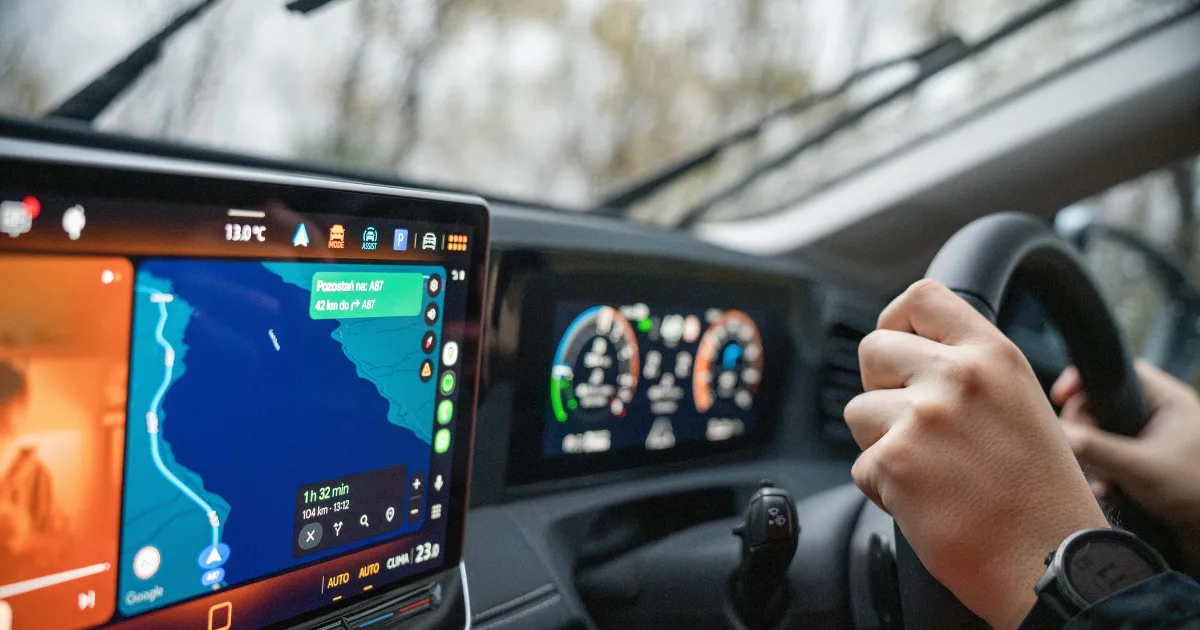
You plan your route in whatever navigation you already trust — Google Maps, Apple Maps, your car’s built-in system. What changes abroad is the charging landscape around that route, and that’s what the app handles. A few of the markets EV drivers cross most often:
- Germany — among the densest fast-charging coverage in Europe, with high-power sites spread along the Autobahn network. See our Germany charging guide.
- France — fast charging is well established on the autoroute network and in the cities. More in our France guide.
- Switzerland — strong coverage on the main corridors; note the country has a mandatory motorway vignette. See Switzerland.
- Spain — rapidly expanding fast charging along the main motorways and the coast. See Spain.
- United Kingdom — extensive but among the pricier markets for public fast charging. See the UK guide.
- Denmark — solid coverage on the Jutland spine and the bridges toward Sweden. See Denmark.
In each one, the in-app routine is identical — only the chargers and the live prices change.
A two-minute pre-trip checklist
Do this once before you leave and charging abroad stops being something you think about:
- Install the app and sign in on the account you’ll use for the trip.
- Order your free RFID card in advance so it’s in the car before you go — get it here.
- Check live pricing as a habit — open the app and look at the current price before every public session, not after.
- Plan the drive in your usual navigation, and let the app handle finding and pricing chargers along the way.
The bottom line
Charging an EV abroad in 2026 shouldn’t mean a new app at every border or a guess at the price. With one account, one free card and live pricing across a network of more than 900,000 charging points in 35 countries, the experience of charging in another country becomes the same as charging at home — just with better scenery. Download the app, order your free card, and let the borders be the only thing that changes.
Frequently asked questions
Can I use the same EV charging app across Europe?
Yes. The easyCharging app works across a European network of more than 900,000 charging points in 35 countries, so you can find chargers, see live pricing and start a session on the same account whether you are at home or driving through another country. There is no need to install a separate app in each market.
Do I need a different charging card in each country?
No. The same easyCharging account and the same free RFID card work across the network in every country it covers. You don't need to collect a wallet full of different operators' cards to cross a border.
Is the easyCharging RFID card free?
Yes, the RFID card is free of charge. It pairs with your account and acts as a backup way to start a charge — useful at older chargers or where mobile signal is weak.
How can I see charging prices in another country before I plug in?
The easyCharging app shows live pricing at charging points across its network, so you can check what a session will cost before you start — even at a charger in a country you have never used. Prices change frequently and vary by operator and speed, so checking live is the only way to know the current rate.
What if I have no mobile signal at a charger abroad?
That is exactly what the free RFID card is for. If you are somewhere with poor coverage, you can tap the card to start a session instead of relying on the app, and the charge still goes to your account.