Charging your EV in Rotterdam

Rotterdam is where the Hull ferry lands and where most UK drivers first touch Dutch tarmac, and it is a city built for driving: wide boulevards, ring roads on three sides, more than 3,400 public charging poles, no low-emission zone for cars and no time limit at a bay while you are plugged in. Two things to know. The kerbside price here ran about 30% above Amsterdam’s in a 2024 Keuze.nl comparison and comes in two tariffs — a fixed one on the newer poles, a monthly-changing one on the older — so the live price before you plug in matters more than anywhere else in the country. And the new A24 tunnel west of the centre charges a small toll by camera. The same app and free card you use at home work from the poles in Kralingen to the 400 kW chargers on the Maas, and right across the Netherlands and over the border.

See the live price before you plug in. One app, one free card — across Rotterdam and all of Europe.

  • Know the price before you charge
  • Free RFID card
  • No subscription
  • Pay as you charge

What charging costs in Rotterdam

Rotterdam’s public poles come in two generations with two tariffs. A pole numbered SGZH2 carries a fixed price for the whole of 2026 — €0.45 per kWh — while a pole numbered SGZH1 carries a variable price that can change every month with the energy market, and a roaming card may add service costs on top of either. In a 2024 Keuze.nl comparison of the four big cities, that made Rotterdam’s kerb the dearest, about 30% above Amsterdam’s. Then there is parking: €6.42 an hour in the centre until 23:00, until 01:00 on Friday and Saturday. easyCharging shows the live price at each pole up front — which tariff, which pole, what your account pays now — so you choose on cost, not on the pole number.

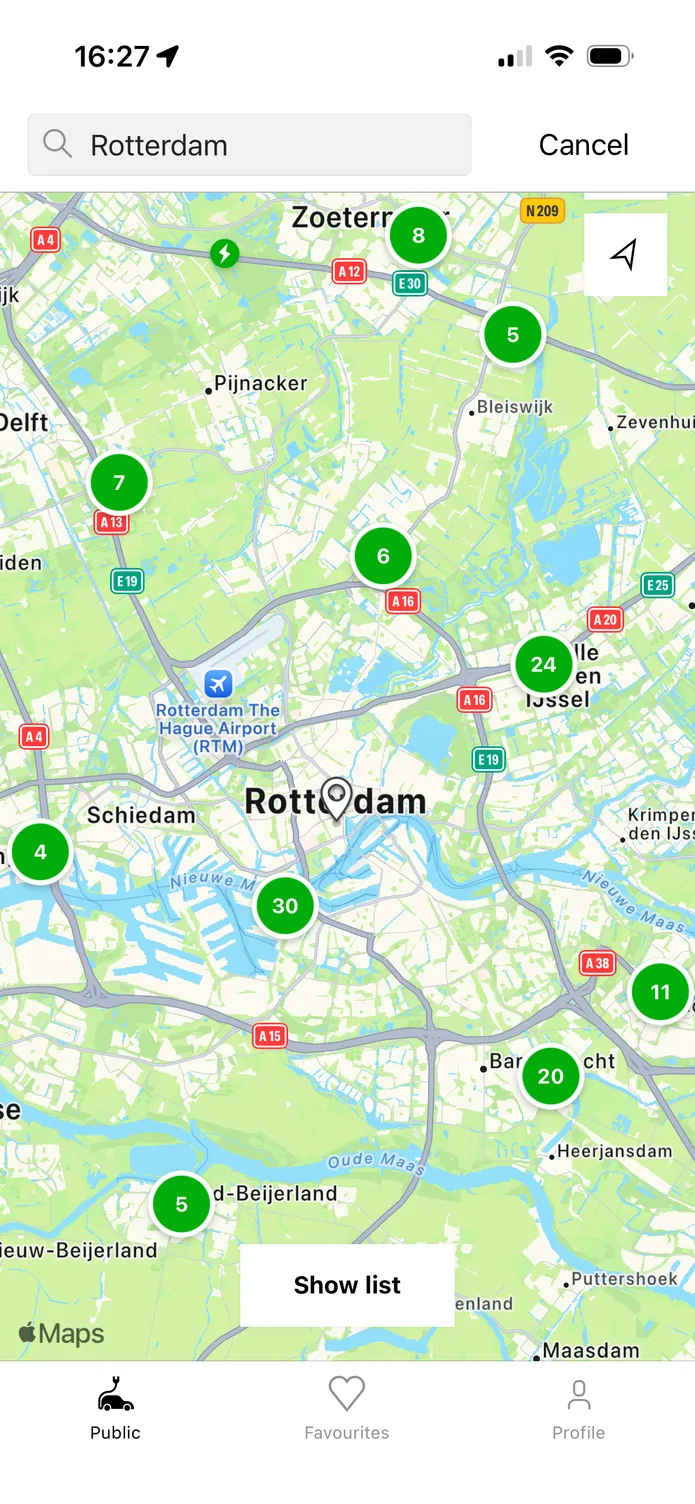
Open the app to see live availability and price across Rotterdam’s poles, P+R bays and hubs on one map.

The easyCharging app showing a live map of charging points across Rotterdam, with the nearest points and their power listed below.

Charging rules and practicalities in Rotterdam

A few local things worth knowing before you charge in the city — from the ferry ramp to the kerb, where the parking is free and the one tunnel on the ring that charges a toll.

  1. Off the ferry, onto the ring

    The P&O ferry from Hull docks at Europoort, out in the port on the A15; the Stena ferry from Harwich docks at Hook of Holland, half an hour west on the A20. Neither crossing offers charging you can count on, so top up before you board — check-in at Europoort opens at 16:00 — and plan the first stop on arrival from the ship: the port area has public charging points and the hubs on the A15 and A20 ring show live in the app. Driving south from the Hook of Holland terminal, the A24 Blankenburg tunnel between the A20 and A15 charges cars €1.57 a trip with no barriers — cameras read the plate, foreign ones included, and you pay at e-tol.nl within 72 hours or register for automatic payment.

  2. No time limit at the pole — but pay the parking

    A bay signed with the P sign and “opladen elektrische voertuigen” is for electric cars while they are connected, and Rotterdam sets no time limit — you may stay as long as you are plugged in, even after the charge completes. In a paid-parking area you pay the parking tariff as well: €6.42 an hour in the centre, €3.20 in the ring of districts around it, €2.24 further out, until 23:00 most nights and until 01:00 on Friday and Saturday in the centre, from 12:00 on Sunday. A car at a pole without valid parking payment, or one that is not plugged in, risks a fine. Cheaper: the P+R sites are free for up to 24 hours if you validate your parking ticket with an OV-chipkaart or RET chip ticket within an hour of returning by metro or tram — mobile tickets, barcodes and bank cards don’t qualify — and P+R Kralingse Zoom and Slinge have 42 and 44 charging bays respectively, with the charging paid separately. A free RFID card starts the charge at any of them without signal.
  3. Where you’ll charge — and the 400 kW on the Maas

    The city counts more than 3,400 public charging poles in every district, and since January 2026 places new ones where usage data shows demand rather than on request. For a fast stop, Shell’s Maasboulevard station already has four CCS points at up to 400 kW, there is a fast-charging hub at Hofplein in the centre on the site of a former petrol station, and Shell’s service stations on the A15 near Alblasserdam and the A16 near Dordrecht are next in line for 400 kW. Rotterdam has no low-emission zone for passenger cars, so there is nothing to register. See more on the Netherlands guide.

How charging works in Rotterdam

Create your account before you sail

Download the easyCharging app on Android or iOS and create your account before you sail. Add a payment method once and you’re ready to charge from the ferry ramp onwards — no Dutch charge card, no second account.

Pick the pole by its price

Open the map and read the price, not the pole number: a fixed-tariff pole and a monthly-tariff pole can stand on the same street, and the app shows what each costs your account right now. Filter for a 400 kW charger when you need speed, or for the free P+R bays when the car can sit for the day.

Plug in, or tap the card

Plug in with your own Type 2 cable and start the session in the app — or tap your free RFID card on the reader in the terminal queue, in a P+R garage or anywhere the signal drops. Pay the parking at the meter or in the parking app for as long as you are plugged in, unless the P+R has made it free.

Unplug, and don’t linger

Stop charging in the app, unplug and continue your journey. You’ll get a charging summary, and payment is handled automatically — no subscription, no monthly invoices. No time limit at the bay is not a reason to leave the car there: unplug and move on when you are done.

Beyond Rotterdam: one app for Europe

Rotterdam is a junction, not a terminus: Belgium is an hour and a quarter south, Amsterdam an hour north, the German border about two hours east. The same app and free card keep working the whole way, with a live price before every stop.

Rotterdam → Amsterdam, or Hook of Holland → Harwich (A4 / A20)

North on the A4 past Delft and The Hague to Amsterdam in about an hour, or half an hour west on the A20 to the Stena terminal at Hook of Holland for the Harwich crossing. Fast chargers at the A4 service areas and the hubs around Delft show live in the app, so the last top-up before the ship is planned rather than hoped for.

Rotterdam → Antwerp → Brussels, Belgium (cross-border, A16 / E19)

South on the A16 past Breda to the Belgian border and Antwerp in about an hour and a quarter, with Brussels an hour beyond. The same app and free card that you use in Rotterdam keep working on Belgian chargers too, with a live price shown before you plug in at each stop along the way.

Rotterdam → Eindhoven → Venlo, Germany (cross-border, A16 / A58 / A67)

South-east on the A16 and A58 to Eindhoven, then the A67 to the German border at Venlo and on to Düsseldorf and the Ruhr — about two hours to the border. There’s no need for a second charging app or card: one app and one free card cover the drive on both sides of the border.

The old way: an app for every network

6 logins · 6 cards · 6 separate bills

The easyCharging way

One app and a free RFID card from the ferry ramp to the German border — find, charge and pay across Rotterdam, the Netherlands and Europe with one account and one bill.

1 app · 1 free card · 1 bill

Why drivers choose easyCharging in Rotterdam

Built for a city you arrive in by ship and drive through, where the price on the pole is the thing to watch.

The price on the pole, before you plug in

Two kerbside tariffs, one of them changing monthly, plus whatever a roaming card adds. The app shows what this pole costs your account right now, before you plug in — the pole number is the app’s problem, not yours.

One app from the ferry ramp onwards

The points around Europoort, the hubs on the A15 and A20 and the 400 kW site on the Maas on one map — plan the first stop from the ship and the last one before check-in.

A card for the terminal and the garage

A free RFID card starts the charge in the terminal queue, in a P+R garage or wherever the signal drops — no app needed at the reader.

No subscription, on the way through

Pay only for the sessions you use. No monthly fee, no commitment — ideal whether Rotterdam is your destination or the first hour of a longer drive.

Rotterdam charging FAQ

Answers to the most common questions about charging an electric car in Rotterdam — the two tariffs, parking at the bay, the ferry ports, P+R, rapid chargers and using the same app abroad.

How much does charging cost in Rotterdam?

More than in Amsterdam — about 30% more at the kerb in a 2024 Keuze.nl comparison of the big cities. Rotterdam’s newer public poles (numbered SGZH2) carry a fixed 2026 price of €0.45 per kWh; the older ones (SGZH1) carry a price that can change every month, and a roaming card may add service costs to either. easyCharging shows the live price for each pole in the app before you plug in, so you can see exactly what a session will be and choose on cost rather than on the pole number. Street parking is charged separately while you are plugged in.

Why do two poles on the same street cost different amounts?

Because they were installed under different city contracts. Poles numbered SGZH1 are on a variable tariff that tracks the energy market month by month; poles numbered SGZH2 are on a fixed yearly tariff. The app reads the price for you — filter by cost and let it pick.

Do I need a Dutch charge card in Rotterdam?

No. One easyCharging app and a free RFID card work across Rotterdam’s poles, P+R bays and hubs — there’s no need for a Netherlands-specific charging app or a separate card for each operator.

Can I charge overnight at a kerbside pole in Rotterdam?

Yes. Rotterdam sets no time limit while you are plugged in, so an overnight charge in a residential street is fine — but paid parking applies at the bay until 23:00 most nights and until 01:00 on Friday and Saturday in the centre, so pay in the parking app for the evening as well. Cheaper still, park free for up to 24 hours at a P+R such as Kralingse Zoom or Slinge, which have charging bays, if you travel on by metro with an OV-chipkaart.

Is there a low-emission zone in Rotterdam I need to register for?

No. Rotterdam has no low-emission zone for passenger cars, so there is nothing to register whatever your plate. The zero-emission zone that started in 2025 applies to vans and lorries only.

Can I charge at the ferry terminal, or on the ship?

Not on the ship — neither crossing offers charging you can count on, so top up before you board. The Europoort port area has public charging points and the hubs on the A15 and A20 ring are minutes away; on the Hook of Holland side, the A20 service areas and the hubs around Delft are the last stop. The app shows availability and the live price for each of them, so the plan is made before you leave the ship or head for check-in.

Where are the rapid chargers in Rotterdam?

Rapid chargers cluster on the ring — the A20 to the north and the A15 through the port — with 400 kW chargers already at Shell’s Maasboulevard station, a fast-charging hub at Hofplein in the centre, and Shell’s service stations on the A15 near Alblasserdam and the A16 near Dordrecht as you leave, both due for the same 400 kW upgrade. You can find them live in the app, with availability and the current price shown before you go.

Is there a toll to drive around Rotterdam?

One on the ring. The A24 Blankenburg tunnel under the Nieuwe Waterweg west of the city, linking the A20 and A15, charges cars €1.57 a trip with no barriers: cameras read the plate, foreign ones included, and you pay at e-tol.nl within 72 hours or register for automatic payment. The Maas tunnel, the Erasmus bridge and the rest of the ring are free; further south-east, the Kiltunnel near Dordrecht charges cars €2.

See all questions

Ready to charge in Rotterdam? Get the app and order your free RFID card.

Get started

English support 24/7

Explore our extensive network

easyCharging offers access to a vast network of 900,000+ charging points across Europe