Charging your EV in Stuttgart
Arriving in Stuttgart — whether for the Mercedes-Benz Museum, the Porsche Museum in Zuffenhausen, or passing through on the A8 — you need a charger, a live price, and nothing else to juggle. From rapid hubs on the A8 and A81 to on-street bays in Mitte and Bad Cannstatt, easyCharging finds it, shows the price, and lets you pay in one place. And when you leave for Munich, Strasbourg or Zürich — the same app and free card keep working.
See the live price before you plug in. One app, one free card — across Stuttgart and all of Europe.
- Know the price before you charge
- Free RFID card
- No subscription
- Pay as you charge
What charging costs in Stuttgart
Prices vary by network and location across Stuttgart. easyCharging shows you the live price at each point up front — so you choose on cost, not guesswork. No app-hopping between networks, whether you're in the city centre or out on the A8.
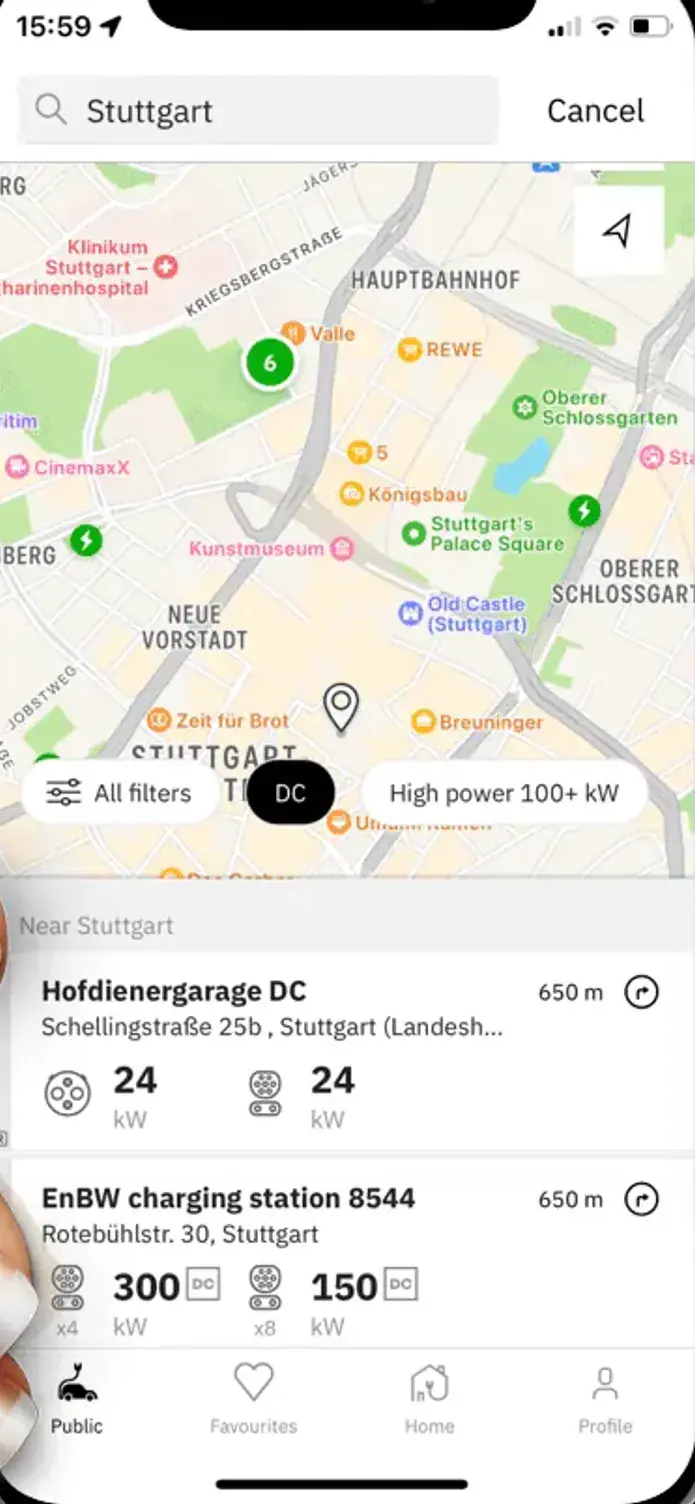
Open the app to see live availability and price across Stuttgart's networks on one map.
Find chargers live in the appCharging rules and practicalities in Stuttgart
Stuttgart has some of Germany's strictest air-quality rules — but none of them touch an EV. Here's what a visitor needs to know before arriving in the Kessel.
Stuttgart's diesel bans — and why an EV drives free
Stuttgart sits in a basin — the Stuttgarter Kessel — ringed by hills that trap air. That geography made it Germany's first city to impose diesel driving bans. Since January 2019 all Euro 4 diesels have been banned city-wide; since July 2020 Euro 5 diesels are also banned in the inner Kessel zone (Bad Cannstatt, Feuerbach, Zuffenhausen). Only Euro 6 diesels — and EVs — move freely. An EV is entirely exempt from both bans: it is not a diesel vehicle. Driving an EV here is the clean answer to exactly the problem Stuttgart's basin created. See the Germany guide for Umweltzone context.
Where you'll charge in Stuttgart
Rapid charging clusters sit along the A8 corridor west of the city — including the large fast-charging park at Rutesheim (up to 300 kW) — and along the A81 heading north and south. Around the Kessel, chargers run along the B14 and B27 arterials. On-street bays are spread across inner districts: Mitte, Bad Cannstatt, Vaihingen, Feuerbach, and Degerloch. Visitor stops include park-and-ride sites on the city periphery, and hotel and museum car parks — including those serving the Mercedes-Benz Museum and the Porsche Museum in Zuffenhausen. One easyCharging app covers Stuttgart's networks — live price shown at every point.
Parking at charging bays
Charging bays in Stuttgart's inner districts and museum car parks often carry time limits — signage varies by location, so it's worth checking on arrival. A free RFID card makes starting a charge quick once you're parked, and is handy in underground hotel or museum car parks where mobile signal can be weak.
How charging works in Stuttgart
Beyond Stuttgart: one app for Europe
Stuttgart sits at the crossroads of two major cross-border corridors — west to France, south to Switzerland. Leave the city and the same app and free card keep working across every border. One app, one free card and a live price the whole way.
Head west on the A8 to Karlsruhe, then south on the A5 to Kehl — crossing the Rhine into Strasbourg in around 90 minutes. The same app and free card that you used in Stuttgart keep working on the French side — with live prices shown before you plug in at each stop. One app, no second account.
Take the A81 south through Singen to the Swiss border — Zürich is roughly 2 hours 20 minutes from Stuttgart. The same app and free card keep working across the border into Switzerland, so you charge with one login the whole way. Note that a Swiss motorway vignette is required on Swiss motorways.
The A8 east connects Stuttgart to Munich in around two hours — one of Germany's most-driven long-distance routes. The same app and free card work the whole way to Munich, with a live price at each rapid hub along the A8.
The old way: an app for every network
6 logins · 6 cards · 6 separate bills
The easyCharging way
One app and a free RFID card replace the whole glovebox — find, charge and pay across Stuttgart, Germany and Europe in one place.
1 app · 1 free card · 1 bill
Why drivers choose easyCharging in Stuttgart
Built for visiting Stuttgart's automotive landmarks and for leaving the city — east to Munich, west to Strasbourg or south to Zürich — without changing apps.
One app
Find, charge and pay across Stuttgart's networks — and across Europe — in a single app, with no app-hopping between operators or borders.
Know the cost up front
See the current price for each charger in the app before you start, so you choose on cost — not guesswork.
Free RFID card
A free RFID card lets you start a charge in an underground car park or anywhere mobile signal drops — handy in museum and hotel car parks in Stuttgart.
No subscription
Pay only when you charge. No monthly fee, no commitment — ideal whether you're a regular visitor or passing through on the A8.
Stuttgart charging FAQ
Answers to the most common questions about charging an electric car in Stuttgart — diesel bans, the Kessel, rapid chargers on the A8 and A81, and using the same app cross-border.
It varies by network and location across Stuttgart. easyCharging shows the live price for each charger in the app before you plug in, so you can see exactly what a session will cost and choose on cost rather than guesswork.
Some locations in Stuttgart offer free AC charging, often at retail or destination car parks. The app shows the live price for each point — including where charging is free — so you can see it before you arrive.
No. One easyCharging app and a free RFID card work across Stuttgart's networks — there's no need for a German-specific charging app or a separate card for each operator.
Yes. On-street charging bays are spread across Stuttgart's inner districts — Mitte, Bad Cannstatt, Vaihingen and others. Bays may carry time limits and rules vary by district, so it's worth checking local signage. The app shows live availability before you set off.
No — EVs are fully exempt. Stuttgart's diesel driving bans (Euro 4 city-wide since 2019; Euro 5 in the inner Kessel zone since 2020) apply only to diesel vehicles. An electric vehicle is not a diesel, so neither ban affects it. EVs drive everywhere in Stuttgart — including the inner Kessel districts — without restriction. The Umweltzone applies to all vehicles, but EVs qualify for the green Umweltplakette and enter freely.
Rapid charging clusters sit along the A8 corridor west of Stuttgart — including a large fast-charging park at Rutesheim offering up to 300 kW — and along the A81 heading north and south. Around the city, chargers run along the B14 and B27. You can find rapid chargers live in the app, with availability and the current price shown before you go.
You pay through the easyCharging app with the payment method on your account. Payment is handled automatically after each session and you receive a charging summary — no subscription and no monthly invoices.
Yes. The same app and free card work across Germany and over the border — including into France (A8/A5 via Karlsruhe to Strasbourg) and into Switzerland (A81 south through Singen to Zürich). No second account, no new card — one login, a live price at every stop.
Yes. The easyCharging RFID card is free. You order it in the app and it's shipped to you, so you can start a charge by tapping the card when signal is weak — handy in Stuttgart's underground museum and hotel car parks.
easyCharging supports the connector types used in Stuttgart and across Germany — CCS and CHAdeMO for DC fast charging, and Type 2 for AC charging. You can filter by your EV's socket type in the app to show only compatible chargers.
Need help while charging?
Contact supportDon't have the app yet?
Download the app