Charging your EV in Hamburg

Hamburg is Germany's great port and its gateway north — and the only major German city with no low-emission zone, so there's no badge to worry about, whatever you drive. From HafenCity and the harbour to the rapid hubs on the A7 through the Elbtunnel, the same app and free card you use at home cover the city — and carry on to Berlin, Munich or north over the border to Denmark, the Copenhagen ferry on the way.

See the live price before you plug in. One app, one free card — across Hamburg and all of Europe.

  • Know the price before you charge
  • Free RFID card
  • No subscription
  • Pay as you charge

What charging costs in Hamburg

Prices vary by network and location across Hamburg. easyCharging shows you the live price at each point up front — so you choose on cost, not guesswork. No app-hopping between networks.

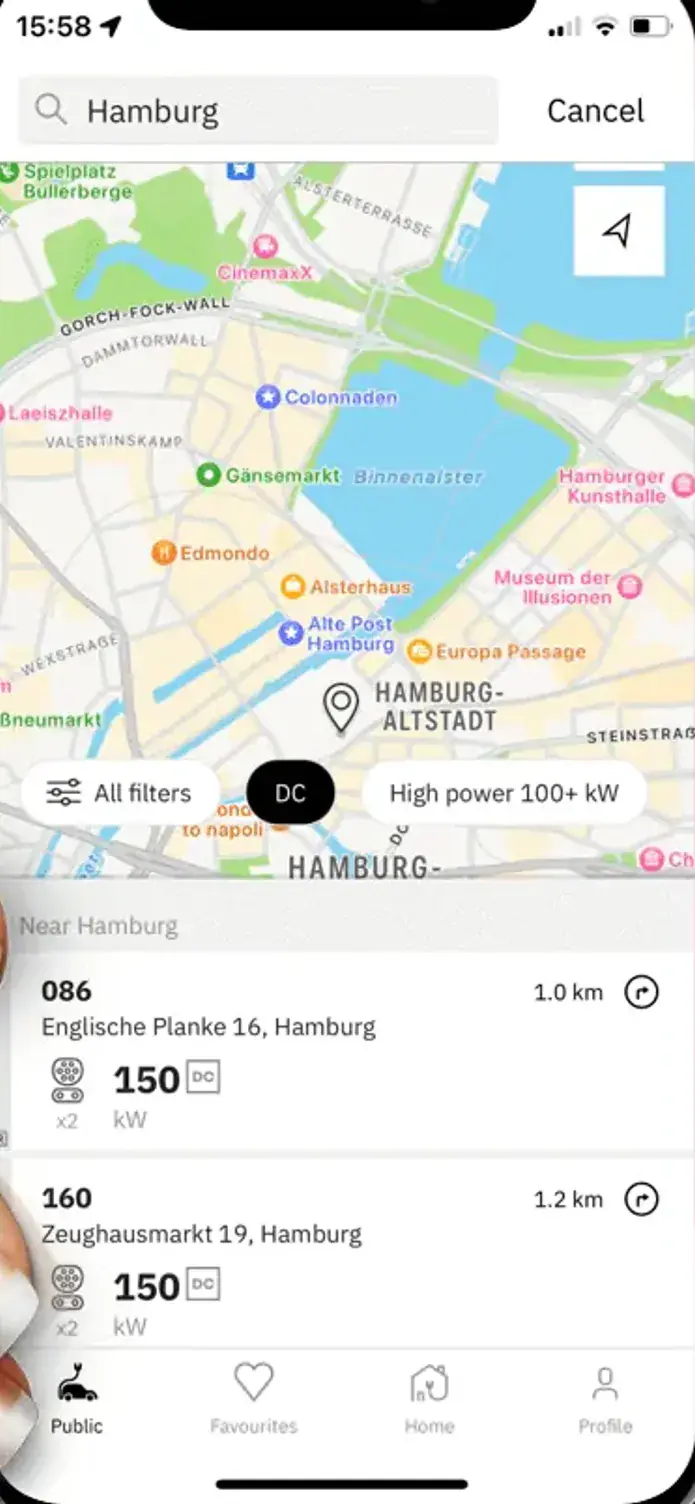
Open the app to see live availability and price across Hamburg's networks on one map.

The easyCharging app showing a live map of charging points across Hamburg, with the nearest points and their power listed below.

Charging rules and practicalities in Hamburg

A few local things worth knowing before you charge in the city — from Hamburg's unique low-emission zone status to where you'll typically find chargers and how parking works.

  1. No low-emission zone in Hamburg

    Hamburg is the only major German city without an Umweltzone. No Umweltplakette (green badge) is needed to drive anywhere in the city. The former diesel street restrictions on Max-Brauer-Allee and Stresemannstraße in Altona were lifted in September 2023. No badge, no restrictions — an EV drives freely throughout Hamburg. See more on the Germany guide.

  2. Where you'll charge

    Hamburg has one of Germany's densest public charging networks — 5,000+ public points running on certified renewable electricity, including 868 fast/DC chargers (HPC up to 150 kW). You'll find rapid hubs near Ring 2 and Ring 3 and along the A1 and A7 through the Elbtunnel, plus convenient charging in HafenCity, port-area car parks, and on-street across Altona, St. Pauli and Eimsbüttel.

  3. Parking at charging bays

    On-street charging bays in Hamburg often carry time limits, and the rules vary from district to district — so it is always worth checking the local signage before you leave the car. Many multi-storey and shopping-centre car parks also let you charge while you are parked. A free RFID card makes starting a charge quick and simple once you have pulled in.

How charging works in Hamburg

Create your account

Download the easyCharging app on Android or iOS and create your account. Add a payment method once and you are ready to charge across Hamburg and beyond.

Find a charger in Hamburg

Use the app to find charging points across Hamburg's networks on one map. Filter by your EV's socket type or charging power, and see live availability and the current price before you go.

Charge your electric car

Plug in and start the session in the app — or tap your free RFID card on the reader; handy in HafenCity car parks or port-area garages where mobile signal can be weak.

Unplug and continue

Stop charging in the app, unplug and continue your journey. You will get a charging summary, and payment is handled automatically — no subscription, no monthly invoices.

Beyond Hamburg: one app for Europe

Leave the city and the same app and free card keep working — across Germany and over the border. One app, one free card and a live price the whole way.

Hamburg → Copenhagen (cross-border, Vogelfluglinie ferry)

Take the A1 north approximately 150 km to Puttgarden on Fehmarn island, then cross on the Scandlines ferry to Rødby in Denmark — the historic Vogelfluglinie route, around 45 minutes on the water. Continue on the E47 to Copenhagen. The same app and free RFID card keep working in Denmark, with a live price shown before every stop.

Hamburg → Berlin (A24, ~237 km)

A straightforward run east along the A24. There is no need for a second app or card — one app and one free card cover the trip, with a live price shown at every stop along the way.

Hamburg → Lübeck / Baltic (A1, ~65 km) or Hamburg → Bremen (A1, ~120 km)

Quick runs east or south along the A1. Lübeck is the gateway to Baltic ferry routes via Travemünde; Bremen opens the road to the Ruhr. The same app works throughout — no second account needed.

The old way: an app for every network

6 logins · 6 cards · 6 separate bills

The easyCharging way

One app and a free RFID card replace the whole glovebox — find, charge and pay across Hamburg, Germany and Europe in one place.

1 app · 1 free card · 1 bill

Why drivers choose easyCharging in Hamburg

Built for charging in Hamburg and for leaving the city — across Germany, Denmark and Europe — without changing apps.

One app

Find, charge and pay across Hamburg's networks — and across Europe — in a single app, with no app-hopping between operators.

Know the cost up front

See the current price for each charger in the app before you start, so you choose on cost — not guesswork.

Free RFID card

A free RFID card lets you start a charge in an underground car park or anywhere mobile signal drops — handy at port-area garages and HafenCity.

No subscription

Pay only when you charge. No monthly fee, no commitment — whether you are visiting once or charging regularly.

Hamburg charging FAQ

Answers to the most common questions about charging an electric car in Hamburg — prices, payment, the low-emission zone, rapid chargers and driving on to Denmark.

How much does charging cost in Hamburg?

It varies by network and location across Hamburg. easyCharging shows the live price for each charger in the app before you plug in, so you can see exactly what a session will cost and choose on cost rather than guesswork.

Are there free charging points in Hamburg?

Some locations in Hamburg offer free AC charging, often at retail or destination car parks. The app shows the live price for each point — including where charging is free — so you can see it before you arrive.

Do I need a German app or card to charge in Hamburg?

No. One easyCharging app and a free RFID card work across Hamburg's networks — there is no need for a German-specific charging app or a separate card for each operator.

Can I charge on-street or overnight in Hamburg?

Yes. On-street charging points are spread across Hamburg's inner districts — Altona, St. Pauli, Eimsbüttel, Winterhude and St. Georg — which suits overnight charging. Bays often carry time limits, so it is worth checking local signage, and the app shows live availability before you set off.

Does Hamburg have a low-emission zone?

No — Hamburg is the only major German city without an Umweltzone (low-emission zone). No Umweltplakette (green badge) is required to drive anywhere in the city. The former diesel street restrictions in Altona were lifted in September 2023. An EV drives freely throughout Hamburg with no badge or restriction to worry about.

Where are the rapid chargers in Hamburg?

Rapid chargers (DC, 50+ kW, up to 150 kW HPC) are found near Ring 2 and Ring 3, and along the autobahn corridors — A1, A7 (including the Elbtunnel approach), A23, A24 and A25. Visitor-convenient fast chargers are also in HafenCity and port-area car parks. You can find them live in the app, with availability and the current price shown before you go.

How do I pay for charging in Hamburg?

You pay through the easyCharging app with the payment method on your account. Payment is handled automatically after each session and you receive a charging summary — no subscription and no monthly invoices.

Can I use the same app to drive to Denmark or Copenhagen?

Yes. The same app and free RFID card keep working after you cross the border. From Hamburg, take the A1 north to Puttgarden, then the Scandlines ferry to Rødby in Denmark (~45 min), and continue on to Copenhagen — one app, one card the whole way.

See all questions

Ready to charge in Hamburg? Get the app and order your free RFID card.

Get started

German support 08:00–19:00 CET · English support 24/7

Explore our extensive network

easyCharging offers access to a vast network of 900,000+ charging points across Europe